
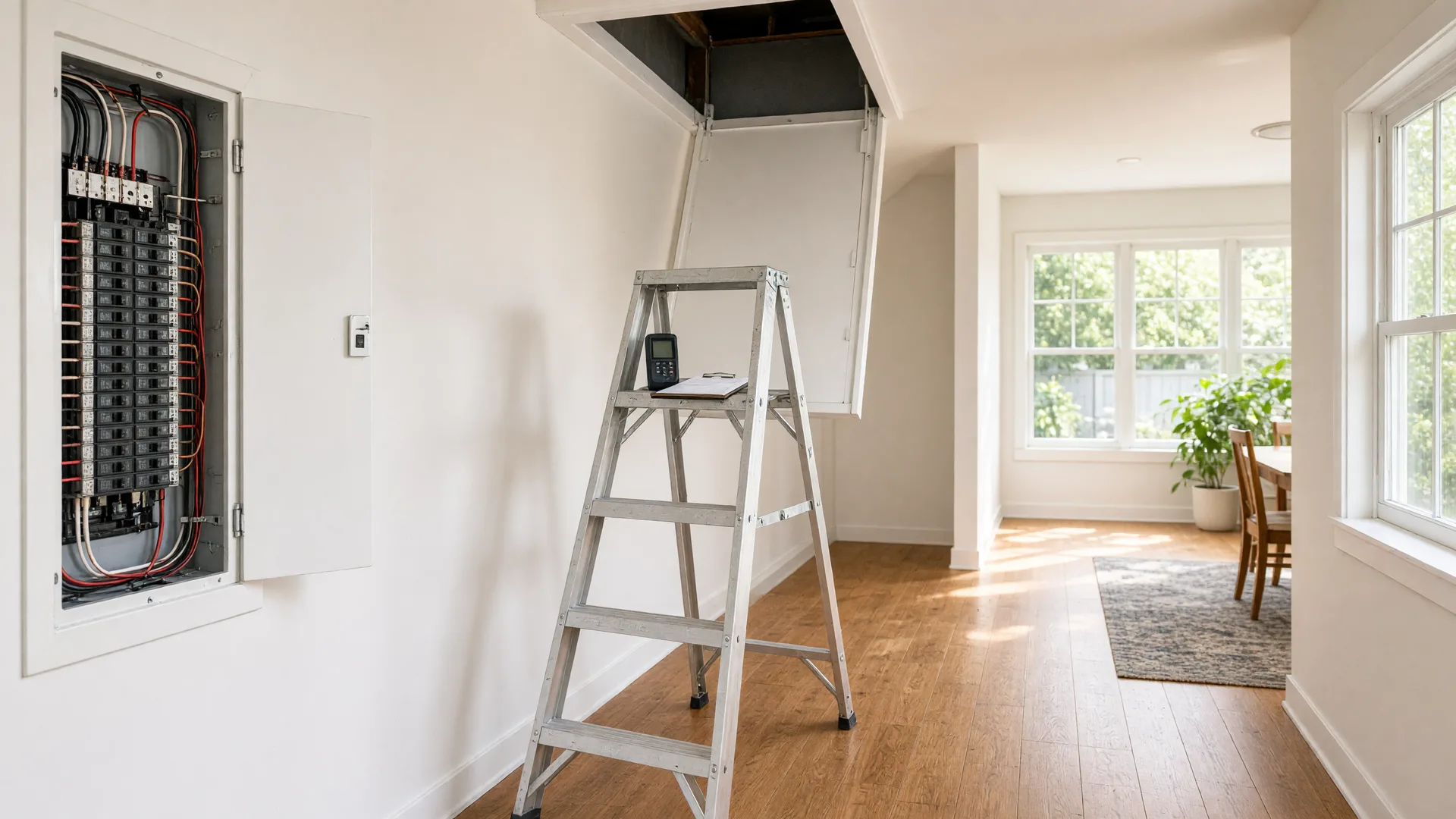
What is a home inspection?
A home inspection is a visual, non-invasive examination of a property's condition, performed by a professional inspector hired by the buyer. It is not a pass or fail test and it is not an appraisal. It is a condition report: what is working, what is aging, what may need attention soon, and what is worth asking about before you close.
California does not license home inspectors, so credentials matter. Look for an inspector with training and membership in a recognized inspection association, such as ASHI (American Society of Home Inspectors) or CREIA (California Real Estate Inspection Association), and ask to see a sample report before you commit. The report is the product you keep, so the quality of the write-up matters as much as the walk-through.
What does a standard inspection cover?
A standard inspection is a top-to-bottom visual check of the visible and accessible parts of the home: the roof and roof drainage, attic and insulation, foundation and overall structure, electrical system, plumbing, heating and air conditioning, water heater, windows and doors, interior walls, floors and ceilings, exterior siding and trim, and attached structures such as decks, patios and garages.
It is deliberately non-invasive. Inspectors do not move furniture, tear open walls, or dig trenches. They report on what they can see, which means hidden issues behind walls, under slabs, or inside sewer lines will not necessarily surface in a general inspection. That is exactly what the add-on inspections below are for.
How much does a home inspection cost in Southern California?
For a typical single-family home in California, expect to pay roughly $400 to $700, with most homes landing in the $450 to $600 band depending on size, age and location. The 2026 cost guides we checked put the California average near $520 to $550, with a wider range of $350 to $900 for especially large, old, or complex properties. See Houzeo's 2026 California cost guide and iBuyer's 2026 state-by-state figures for the underlying surveys, and our full home inspection cost answer in the Q&A hub.
Specialty inspections are priced separately and typically add $75 to $350 each: a pest and termite report, a sewer lateral scope, a roof certification, a pool inspection, a mold screening, or a structural engineer's review. Buyers pay for these out of pocket, and routine inspections are not covered by homeowners insurance.
One honest piece of advice: do not pick an inspector on price alone. A low bid that misses a failing sewer line costs far more than a thorough inspection that catches it. We keep a short list of inspectors we have watched work and we are glad to share it, because the report has to be independent.
When does the inspection happen after an offer is accepted?
The inspection happens during the inspection contingency, the period in the purchase contract that protects the buyer's right to inspect. Under the standard California Association of REALTORS Residential Purchase Agreement, the default period is 17 days from acceptance, and it is negotiable up or down depending on the market.
California uses active removal: the contingency does not expire on its own. Before the deadline, the buyer must take a written step, either signing a Contingency Removal form, negotiating, or canceling the contract in writing. If the buyer does nothing, the seller can serve a notice to perform and the deal can stall over paperwork. Your agent's job is to make sure that never happens.
In competitive Inland Empire markets, buyers sometimes shorten or waive the inspection contingency to make an offer more attractive. Weakening the contingency is a strategy; skipping the inspection itself is a separate, riskier decision. We will help you understand what you would be giving up before you give it up.
Most inspections are scheduled within the first week after acceptance, so the report lands early in the 17-day window and leaves room to negotiate.
What happens if the inspection finds problems?
Almost every report lists items, and most are minor: worn caulking, a dripping valve, a missing outlet cover. A few are major: an aging roof, an outdated electrical panel, foundation cracks, an old sewer line. Almost nothing is automatically a deal-ender.
Once the report is in, the buyer has four options: accept the home as-is and move forward, ask the seller to make repairs, ask for a credit or price reduction to cover the work, or cancel within the contingency and get the earnest money deposit back. The seller can agree, counter, or refuse; under the standard contract, the sale is as-is unless both sides agree otherwise.
When an issue is real but repairable, the smartest move is usually to get two or three contractor bids before negotiating, so the request is grounded in actual dollars instead of a guess. If you are not sure which findings matter, the repairs before selling Q&A walks through when fixes pay off and when they do not.
Which extra inspections are worth paying for in the Inland Empire?
The general inspection is the baseline; the add-ons are where local knowledge pays off. In California, a pest and termite report is standard practice and frequently requested by lenders or buyers, because wood-destroying organisms are common across the region. A sewer lateral scope is worth it for older homes on lots with mature trees, where roots can block or crack the line to the street.
Older foothill homes in places like Yucaipa and Cherry Valley can show roof, foundation and drainage issues, so a structural review and roof certification often pay for themselves. If the property has a pool, a separate pool inspection covers equipment most general inspectors only glance at. For new construction, a pre-drywall inspection catches framing, electrical and plumbing issues while they are still visible, which is why we recommend one in growing communities like Menifee and Beaumont. Ask your inspector which add-ons they recommend for the specific home; a good one recommends by condition, not by upsell.
How should sellers prepare for the buyer's inspection?
Sellers have three honest choices. The first is a pre-listing inspection: hire an inspector before the home goes on the market, so you know what a buyer will find. Fix what is cheap to fix, disclose what you know, and price the rest honestly. The second is to handle issues when the buyer's report arrives, which works well when the home is clean but invites renegotiation on older homes. The third is an as-is route: list for cash sale at a price that reflects the condition, with no repair requests expected.
Whichever path you choose, California law requires sellers to disclose known material defects in writing, most often through the Transfer Disclosure Statement, so a known issue you hide usually becomes a bigger problem later. If repairs would not return their cost, an as-is sale with honest disclosure is a legitimate choice, and our cash offers versus traditional listings comparison lays out the numbers side by side.
For sellers who want the home inspection-ready before listing, Julian's Smart Seller Method is one structured prep approach, and a traditional listing remains a straightforward option for most homes. Smart programs are one option among several, subject to eligibility and written terms, and no particular result is guaranteed.
Frequently asked questions about home inspections
Who pays for the home inspection? The buyer pays. A standard single-family inspection runs roughly $400 to $700 plus any add-ons, paid directly to the inspector, usually at the time of service.
How long does the inspection take? Plan on two to four hours on site for a typical single-family home, longer for large or older properties. The written report usually arrives within 24 to 48 hours, and often the same day.
Should the buyer attend the inspection? Yes, at least for the final walk-through. You learn the most by following the inspector, asking questions, and hearing how issues are described, not just reading them.
Is a home inspection the same as an appraisal? No. The appraisal is the lender's opinion of value, ordered by the mortgage company. The inspection is the buyer's look at condition. You need both, and they answer different questions.
Can the seller refuse to make repairs? Yes. Under the standard contract the sale is as-is unless both sides agree otherwise. When a seller refuses, the buyer decides whether to accept the home as-is, negotiate credits, or cancel during the contingency.
Do brand-new homes need an inspection? Yes. Builder warranties are not a substitute for an independent check, and a pre-drywall inspection can catch issues while they are still fixable. Our new construction buyer's guide covers the rest of the process.
What a home inspection means for your next move
A home inspection never tells you whether to buy or sell. It tells you what you are buying or selling, and that is what makes it worth the money. On any home, the inspection fee is a small fraction of the purchase price, and it buys information you cannot get any other way.
If you are buying, the Inland Empire home buying guide walks through every step from offer to keys, and the first-time buyer page covers the costs to plan for. If you are selling, a free home value estimate is the honest starting point, because you cannot decide what to fix, disclose, or discount until you know what the home is worth.
Getting a straight answer is easy: book a free, no-pressure Smart Call on the schedule page, call 951-456-4209, or email info@searchsocal.com. Julian Cesar, AI-Certified Agent, Search SoCal Real Estate, Compass. Agent license CA DRE #02015349; broker: Compass, CA DRE #01527365. The education comes first, and the numbers come before any opinion.
Frequently asked questions
Who pays for the home inspection?
The buyer pays. A standard single-family inspection runs roughly $400 to $700 plus any add-ons, paid directly to the inspector, usually at the time of service.
How long does the inspection take?
Plan on two to four hours on site for a typical single-family home, longer for large or older properties. The written report usually arrives within 24 to 48 hours, and often the same day.
Should the buyer attend the inspection?
Yes, at least for the final walk-through. You learn the most by following the inspector, asking questions, and hearing how issues are described, not just reading them.
Is a home inspection the same as an appraisal?
No. The appraisal is the lender's opinion of value, ordered by the mortgage company. The inspection is the buyer's look at condition. You need both, and they answer different questions.
Can the seller refuse to make repairs?
Yes. Under the standard contract the sale is as-is unless both sides agree otherwise. When a seller refuses, the buyer decides whether to accept the home as-is, negotiate credits, or cancel during the contingency.
Do brand-new homes need an inspection?
Yes. Builder warranties are not a substitute for an independent check, and a pre-drywall inspection can catch issues while they are still fixable.